Headache Treatment in Provo, Utah
Identifying the cervical and biomechanical causes of headaches — not just treating the pain.
Many recurring headaches start in the neck. The top three joints of the neck share a pain pathway with the head, so a problem at the base of the skull can be felt behind the eyes, in the temples or across the forehead. Our first job is to work out whether your headache is coming from your neck. If it is, we find which level is involved and what is loading it: a stiff joint, an old whiplash injury, or a head that sits too far forward all day.
Our clinic is at 385 N 500 W in central Provo. Same-day visits are often available: call 801-373-1035.
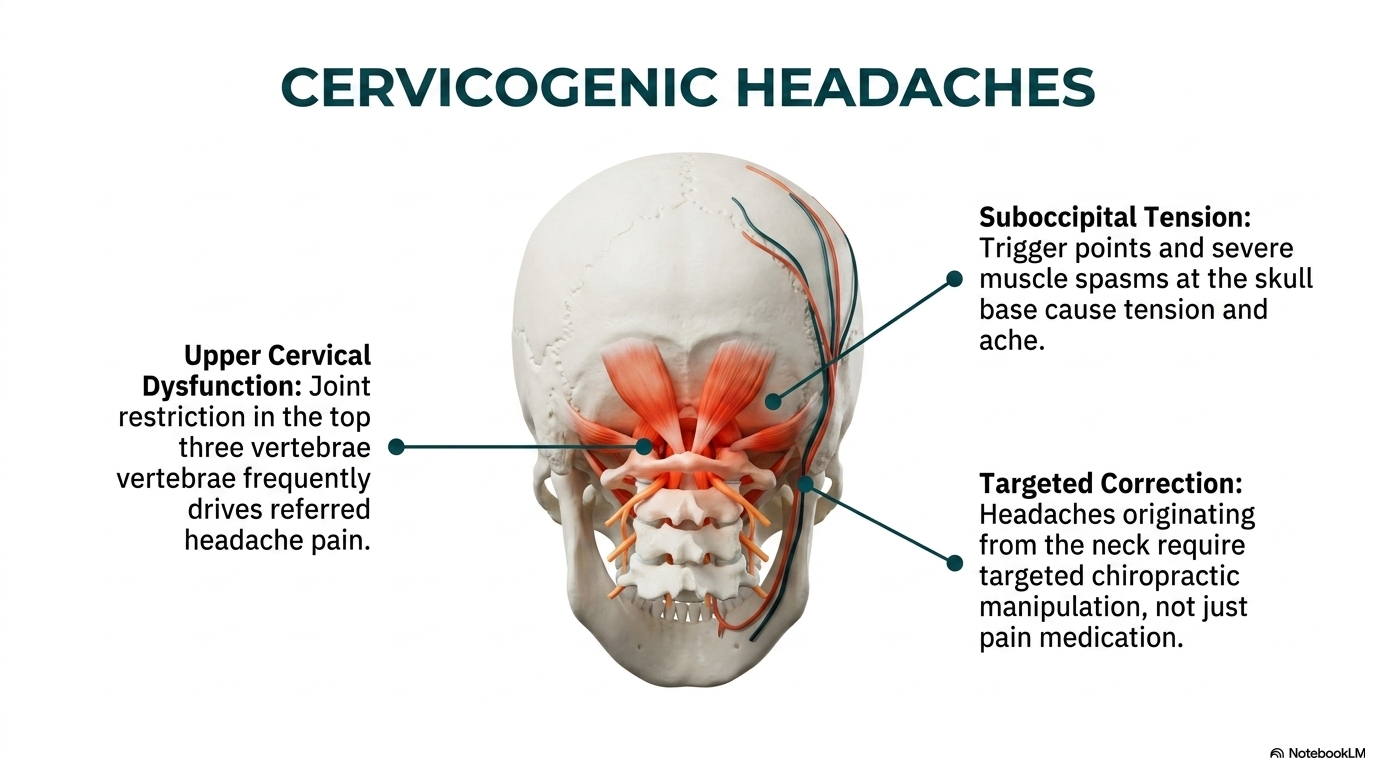
Cervicogenic and Tension Headaches
Many recurrent headaches originate in the cervical spine. Cervicogenic headaches arise from irritation of the upper cervical nerve roots (C1, C2, C3) and the trigeminal nucleus caudalis — a shared pain processing center that explains why cervical dysfunction produces pain felt in the head, eyes, temples, and sinuses.
Tension-type headaches — the most common headache type — are frequently driven by suboccipital muscle hypertonicity, upper cervical joint restriction, and forward head posture that compresses the C0-C1 articulation. These are mechanical problems with mechanical solutions, not chemical imbalances that require long-term medication.
Patients with post-concussion syndrome, post-whiplash headaches, and chronic daily headaches often have identifiable cervical biomechanical dysfunction that is missed on standard neurological workup — and that responds well to targeted chiropractic care.
Our Approach to Headache Care
Upper Cervical Evaluation
We evaluate the upper cervical spine (occiput, C1, C2) — the most common structural source of cervicogenic headaches. Restriction at the atlanto-occipital or atlanto-axial joints directly irritates the suboccipital nerve complex and produces referred head pain.
Cervical Adjustments
Targeted mobilization of restricted upper and mid-cervical segments calms the irritated joints at the top of your neck that send pain into your head. Many patients notice a change within the first few weeks, and we track it with you visit to visit.
Postural and Mechanical Correction
Forward head posture increases compressive load on the upper cervical segments significantly for every inch of forward displacement. Addressing the postural and mechanical drivers prevents recurrence beyond the treatment period.
How we look for the source
- Upper-neck exam. We test how the top of your neck moves and which movements reproduce your headache.
- Posture, measured. Dr. Matt McClean, who is certified in Chiropractic BioPhysics (CBP), measures your neck curve and head position on X-ray, so we can track real change instead of guessing.
- Motion X-ray when there is an injury history. After whiplash or a head injury, Digital Motion X-ray (DMX) shows how your upper neck moves while you are upright.
- Neck strength and control. We test and retrain the muscles that hold your head up on a neck exercise machine designed and built in our clinic, which measures your force and gives you real-time biofeedback.
- When it is not the neck. A sudden “worst headache of your life,” a headache with weakness, confusion or vision loss, or a new headache after age 50 needs a medical evaluation first. We will tell you, and help you get there.
Spinal Biomechanics Training Applied to Headache Care
Fellowship training in spinal biomechanics and trauma includes deep study of the craniocervical junction — the mechanical interface between the skull and cervical spine where most cervicogenic headaches originate. This gives our doctors training most providers don’t have in how the skull and upper neck work together.
When headaches suggest vascular or intracranial pathology, appropriate neurological screening and referral protocols are applied immediately. Patient safety and accurate diagnosis always come first.
Frequently Asked Questions
How do I know if my headaches are coming from my neck?
Key indicators of cervicogenic headaches: pain begins in the neck or base of skull and radiates to the head; headache worsens with certain neck positions or sustained posture; you have associated neck stiffness or restricted range of motion; headaches began or worsened after a neck injury. Diagnostic nerve blocks can confirm the diagnosis definitively.
Can chiropractic care replace my headache medication?
For cervicogenic and tension-type headaches, many patients reduce or eliminate medication reliance after successful treatment of the underlying cervical cause. We do not manage your medications — that is your prescribing physician’s role — but addressing the structural source often makes long-term medication unnecessary.
What types of headaches won’t respond to chiropractic care?
Headaches from conditions inside the skull (such as a tumor or aneurysm), cluster headaches, and headaches from whole-body illness need medical care. Migraines are mixed: some patients are helped, especially when neck problems are part of the picture, and we will tell you honestly what we think after your exam.
Can a chiropractor help headaches?
Yes, particularly headaches that start from the joints and muscles of the upper neck. Restoring normal neck motion often reduces how often and how hard they hit.
Are headaches after a car accident normal?
They are common after whiplash. The same neck structures injured in a crash can refer pain into the head. These respond well to care aimed at the neck.
How long until headaches improve with care?
Many patients notice fewer headaches within a few weeks. The cause and history shape the timeline, which we track from visit to visit.
When should a headache be checked right away?
A sudden, severe headache, or one with vision changes, weakness, or confusion, needs urgent medical care. We help you know the difference.
Clinical Evidence
Bryans et al., 2011
Evidence-based guidelines from the Journal of Manipulative and Physiological Therapeutics found evidence supporting spinal manipulation for cervicogenic headache and for migraine. The evidence for tension-type headache was weaker.
Nilsson et al., 1997
In a randomized controlled trial of patients with cervicogenic headache, the manipulation group improved significantly more than a control group treated with low-level laser and massage, with less pain medication use, lower headache intensity and fewer headache hours.
Boline et al., 1995
A head-to-head RCT comparing spinal manipulation to amitriptyline (a common headache medication) for chronic tension-type headaches found equivalent improvement during the treatment period — but only the spinal manipulation group maintained benefits after treatment ended, while the medication group returned to baseline.
References
- Bryans R, et al. Evidence-based guidelines for the chiropractic treatment of adults with headache. J Manipulative Physiol Ther. 2011;34(5):274-289.
- Nilsson N, Christensen HW, Hartvigsen J. The effect of spinal manipulation in the treatment of cervicogenic headache. J Manipulative Physiol Ther. 1997;20(5):326-330.
- Boline PD, et al. Spinal manipulation vs amitriptyline for the treatment of chronic tension-type headaches. J Manipulative Physiol Ther. 1995;18(3):148-154.