Neck Pain Treatment in Provo, Utah
Structural evaluation and hands-on chiropractic care for cervical spine pain — serving Utah County since 1965.
Neck pain usually comes from one of a few places: a joint that is stiff or irritated, a disc, a pinched nerve root, or a neck that has lost its normal curve and is holding your head too far forward. Each of those needs a different plan. That is why we figure out which one you have before we treat it.
Our clinic is at 385 N 500 W in central Provo. Same-day visits are often available: call 801-373-1035.
Understanding Neck Pain
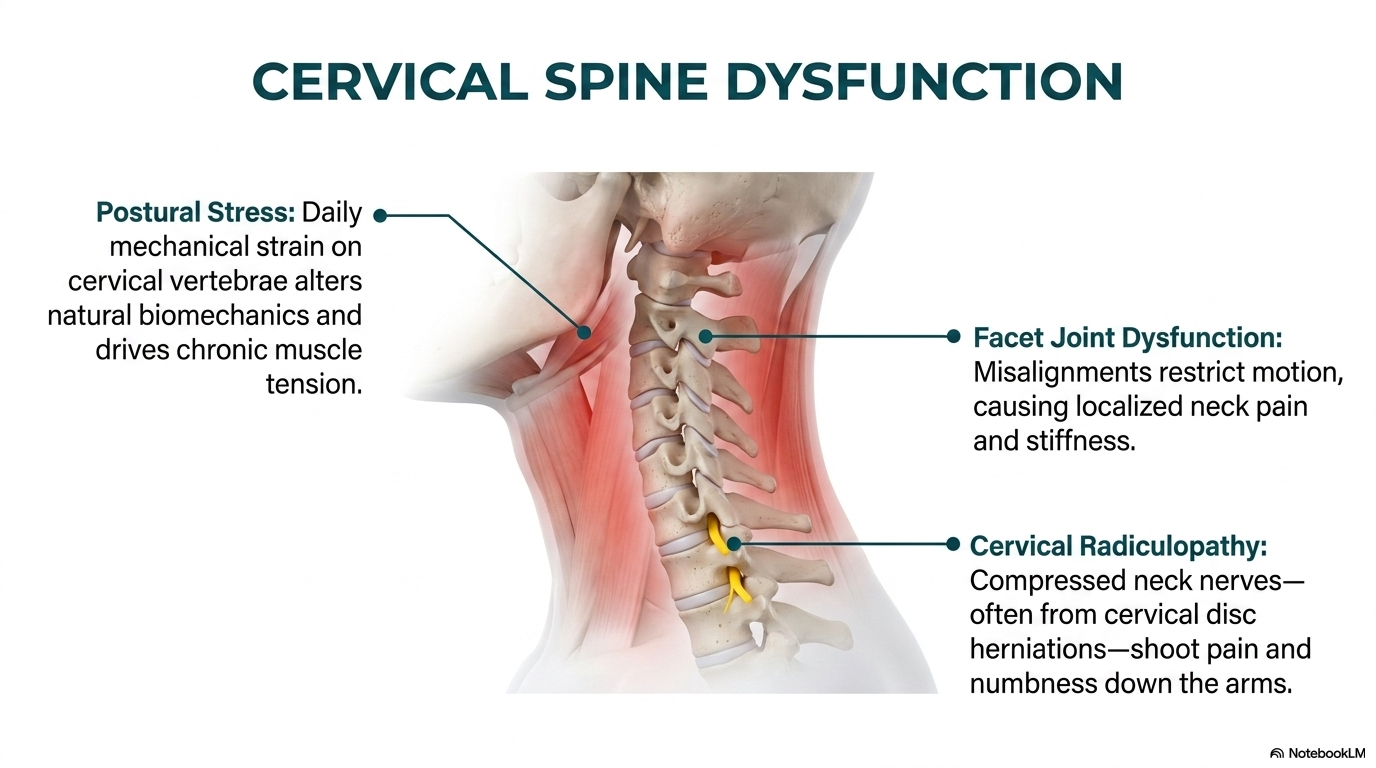
Neck pain affects up to 70% of adults at some point in their life. The cervical spine houses the spinal cord, eight cervical nerve roots, and the vertebral arteries — making it one of the most functionally critical and mechanically complex regions of the body.
Common causes include cervical disc herniation, facet joint dysfunction, ligament instability (particularly following whiplash), muscle strain, degenerative disc disease, and poor postural mechanics. Because the cervical nerve roots supply the arms, shoulders, and hands, neck problems frequently cause symptoms far from the neck itself.
Our Cervical Spine Approach
Motion X-Ray (DMX) Evaluation
Dynamic motion X-ray is the best way we have to see cervical ligament instability — the most commonly missed finding after neck injuries. Static imaging cannot show this; only real-time video fluoroscopy captures abnormal segmental motion under load.
Cervical Adjustments
Targeted mobilization and manipulation of restricted cervical segments loosens stiff joints so your neck moves normally again, and the pain they send into your head and arms settles down.
MRI Interpretation
Our doctors review MRI series directly — not just the radiologist summary — using fellowship-level training and AI-assisted analysis to identify disc herniation levels, foraminal narrowing, cord signal changes, and ligament disruption.
Your head is heavier than you think
Every inch your head drifts forward adds load that the muscles at the back of your neck have to carry, all day. It is one of the most common reasons neck pain keeps coming back.
Dr. Matt McClean, who is certified in Chiropractic BioPhysics (CBP), measures your neck curve and head position on X-ray, so we can track real change. We treat the joints that are stuck, then retrain the muscles that hold your head up, including on a neck exercise machine designed and built in our clinic that measures your force and gives you real-time biofeedback.
FSBT-Trained Cervical Spine Specialists
The Fellowship in Spinal Biomechanics and Trauma (FSBT) includes advanced training in cervical spine mechanics, ligament injury assessment, and MRI interpretation — skills not taught in standard chiropractic programs. This training is why our doctors are well prepared to evaluate complex cervical spine conditions.
McClean Chiropractic has served Provo and Utah County since 1965. When cervical conditions require surgical consultation or interventional pain management, we have established referral relationships with the appropriate specialists.
Frequently Asked Questions
Can neck pain cause arm pain and numbness?
Yes. Cervical nerve root compression (cervical radiculopathy) from a herniated disc or bone spur causes pain, numbness, and weakness that travel down the arm. C6 nerve involvement produces symptoms in the thumb and index finger; C7 affects the middle finger; C8 affects the ring and pinky fingers. Identifying the exact level guides specific treatment.
Is chiropractic safe for neck pain?
Yes, when performed by trained practitioners following proper examination. We conduct a thorough evaluation before any cervical treatment, including screening for contraindications. Fellowship training includes advanced cervical safety protocols.
My neck has been hurting for years — is it too late?
Chronic neck pain often responds well to care that addresses the underlying mechanical dysfunction. Even long-standing problems can improve significantly when the structural cause is identified and treated — not just the symptoms.
Can a chiropractor help neck pain?
Yes. Most neck pain comes from joints, discs, or muscles that are not moving correctly. Gentle adjustments, soft tissue work, and targeted exercises restore normal motion and ease pain. We first check how your neck moves so the treatment fits your specific problem.
How long does it take for neck pain to improve?
Many patients feel better within a few visits, though lasting change depends on how long the problem has been there and what is causing it. We track your response and adjust the plan.
What causes neck pain that will not go away?
Persistent neck pain is often a movement or joint problem that imaging alone misses. Motion X-ray shows how your neck behaves under load, which helps us find the real driver.
Should I see a chiropractor or a doctor for neck pain?
If your pain followed an injury, comes with numbness, or is not improving, get evaluated. Our doctors read your imaging and exam together and refer out when something needs it.
Clinical Evidence
Hoving et al., 2002
A randomized controlled trial in Annals of Internal Medicine (n=183) found manual therapy produced faster recovery from neck pain than physical therapy or continued GP care, with significantly greater improvement in pain, disability, and patient satisfaction at 7 weeks.
Bronfort et al., 2012
An Annals of Internal Medicine RCT comparing spinal manipulative therapy, home exercise with advice, and medication for acute/subacute neck pain found that spinal manipulation produced superior pain reduction at 12 weeks and at 12 months compared to medication — without medication’s side effect profile.
Hurwitz et al., 1996
A systematic review in Spine concluded that spinal manipulation and mobilization probably provide at least short-term benefit for some patients with neck pain and headache.
References
- Hoving JL, et al. Manual therapy, physical therapy, or continued care by a general practitioner for patients with neck pain. Ann Intern Med. 2002;136(10):713-722.
- Bronfort G, et al. Spinal manipulation, medication, or home exercise with advice for acute and subacute neck pain. Ann Intern Med. 2012;156(1):1-10.
- Hurwitz EL, et al. Manipulation and mobilization of the cervical spine: a systematic review of the literature. Spine. 1996;21(15):1746-1759.
Schedule Your Consultation Today
Fellowship-trained spine specialists serving Provo and all of Utah County.
More From Our Spine Education Library
Articles from our fellowship-trained doctors on the topics above:
Neck pain that returns is a stability problem
If your neck feels better after care but the pain keeps creeping back, the muscles that steady your spine may be firing late or unevenly. Our computerized spine stability program measures it objectively and retrains it with exact numbers.