Your jaw pain and your neck pain are often the same problem - and treating one without the other rarely works.
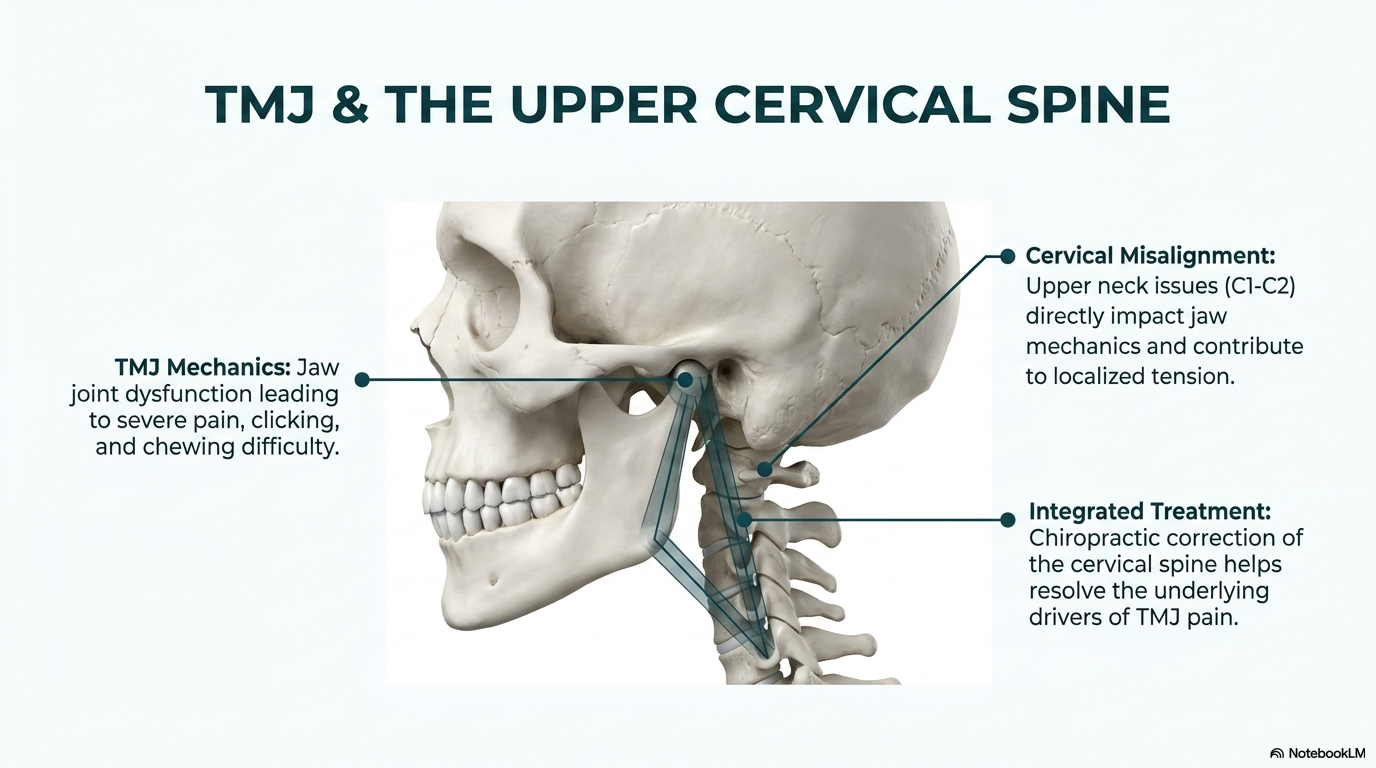
The TMJ-Cervical Spine Connection
The temporomandibular joint (TMJ) and the upper cervical spine share nerve pathways and biomechanical relationships that most providers do not address. Forward head posture – extremely common in people with neck pain – directly loads the jaw joint abnormally. Conversely, chronic jaw clenching and TMJ dysfunction feeds tension into the suboccipital muscles, triggering headaches and neck stiffness. You cannot fully resolve one without addressing the other.
TMJ Symptoms We Help With
Jaw Pain & Clicking
Pain in the jaw joint, clicking or popping with mouth opening, and difficulty chewing are classic TMJ signs often driven by cervical dysfunction.
Headaches from the Jaw
The trigeminal nerve connects the TMJ to the same pathways as headache pain. TMJ dysfunction is a significant trigger for chronic headaches and migraines.
Ear Pain & Fullness
The TMJ sits directly in front of the ear canal. Dysfunction in the joint produces ear symptoms – pain, pressure, ringing – with no ear problem present.
Forward Head Posture
The most common structural driver of TMJ overload. Every inch of forward head posture adds 10 lbs of abnormal load to the cervical spine – and the jaw compensates.
Neck Pain With Jaw Involvement
Chronic neck tightness – especially in the sternocleidomastoid and scalene muscles – directly strains the jaw and contributes to clenching.
Post-Accident TMJ Injury
Whiplash trauma can injure the TMJ directly or through the cervical biomechanical disruption that follows. This is frequently missed in accident evaluations.
Fellowship-Trained. Rarely Matched.
Our doctors hold the FSBT designation – Fellowship in Spinal Biomechanics and Trauma. This post-doctoral training is pursued by a small fraction of chiropractors and equips our team with advanced expertise in spinal imaging, ligament injury assessment, and trauma biomechanics. You get a level of analysis that most chiropractic clinics simply cannot offer.
Frequently Asked Questions
Do chiropractors treat the jaw joint directly?
We treat the cervical spine and associated soft tissue that contribute to TMJ dysfunction. Direct jaw joint treatment is coordinated with your dentist when needed.
Should I see a dentist or a chiropractor for TMJ?
Ideally both. Dentists address bite and splint therapy. We address the cervical spine and postural factors. Treating both sides gives the best outcomes.
How is TMJ related to my car accident?
Whiplash can injure the TMJ directly (especially in rear-end collisions where the jaw is forced backward) and creates the cervical dysfunction that loads the jaw abnormally afterward.
Can you help with teeth grinding (bruxism)?
We address the cervical and muscular tension component of bruxism. Splint therapy and bite adjustment from a dentist addresses the jaw mechanics. We work best as a team.
Ready to Get Relief?
Call us today or request an appointment online. Same-day appointments are often available.
How we treat TMJ dysfunction
TMJ and the cervical spine are connected
- Upper cervical dysfunction drives many TMJ symptoms
- Whiplash and head trauma commonly trigger TMJ issues
- Posture and forward head position load the jaw joint
- Dental occlusion is one factor but rarely the only factor
What we actually do
- Upper cervical evaluation and correction
- Direct TMJ joint mobilization when indicated
- Masseter, temporalis, and pterygoid soft-tissue work
- Cold laser for inflamed joint capsule
- Coordination with your dentist when a splint is involved
What our patients say
“I think that McClean Chiropractic is wonderful. It saved me a ton of money when they fixed my TMJ and now they have fixed my back. Thank you very much McClean Chiropractic.”
. Ammon F., Google review
“Dr. Gordon has helped me so much! I came with bad headaches daily and a really bad neck. The headaches are all but gone.”
. Connie D., Google review
TMJ / jaw pain FAQ
No. Many TMJ cases benefit from both chiropractic and dental input (particularly for bite splints). We coordinate with your dentist when that’s useful.
Often yes, particularly if the cervical spine has never been evaluated. Long-standing TMJ often has a neck-driven component no one has addressed.
Common drivers: whiplash or head trauma, forward head posture, clenching/ grinding, dental work, and upper cervical segmental dysfunction. Usually more than one factor.
The upper cervical work is very gentle. Direct TMJ work. Both external and sometimes intraoral. Can be briefly uncomfortable but shouldn’t be painful in a lasting way.
Mild to moderate cases: 6-10 visits over 4-6 weeks for most patients. Severe or long-standing cases take longer and often benefit from combined chiropractic + dental splint management.
Yes, when indicated and with your consent. It’s the most direct way to release the pterygoid muscles that drive many jaw symptoms.
Jaw clicking, popping, or locking? Let's evaluate it.
Same-week appointments available. Insurance accepted. Let’s get you a real evaluation and a plan.
McClean Chiropractic · 385 N 500 W, Provo UT 84601
Clinical Evidence
KALAMIR A, ET AL., 2010
Intraoral myofascial therapy for chronic myogenous temporomandibular disorder: a randomized controlled trial showed significant reduction in pain and jaw dysfunction.
CUCCIA AM, ET AL., 2010
Osteopathic manual treatment applied to temporomandibular disorders demonstrated improvements in mouth opening and pain reduction.
FRICTON J., 2007
Myofascial pain mechanisms to management review identifies manual therapy as a primary evidence-based intervention for TMJ-related myofascial conditions.
References
- Kalamir A, et al. Intraoral myofascial therapy for chronic myogenous temporomandibular disorder: a randomized controlled trial. J Manipulative Physiol Ther. 2010;33(1):36-41.
- Cuccia AM, et al. Osteopathic manual treatment applied to temporomandibular disorders. J Bodyw Mov Ther. 2010;14(4):348-53.
- Fricton J. Myofascial pain: mechanisms to management. Oral Maxillofac Surg Clin North Am. 2007;19(2):255-66.
Related at McClean Chiropractic