Burning, tingling, weakness, or radiating pain - these are nerve symptoms, and they need the right diagnosis.
What a Pinched Nerve Really Is
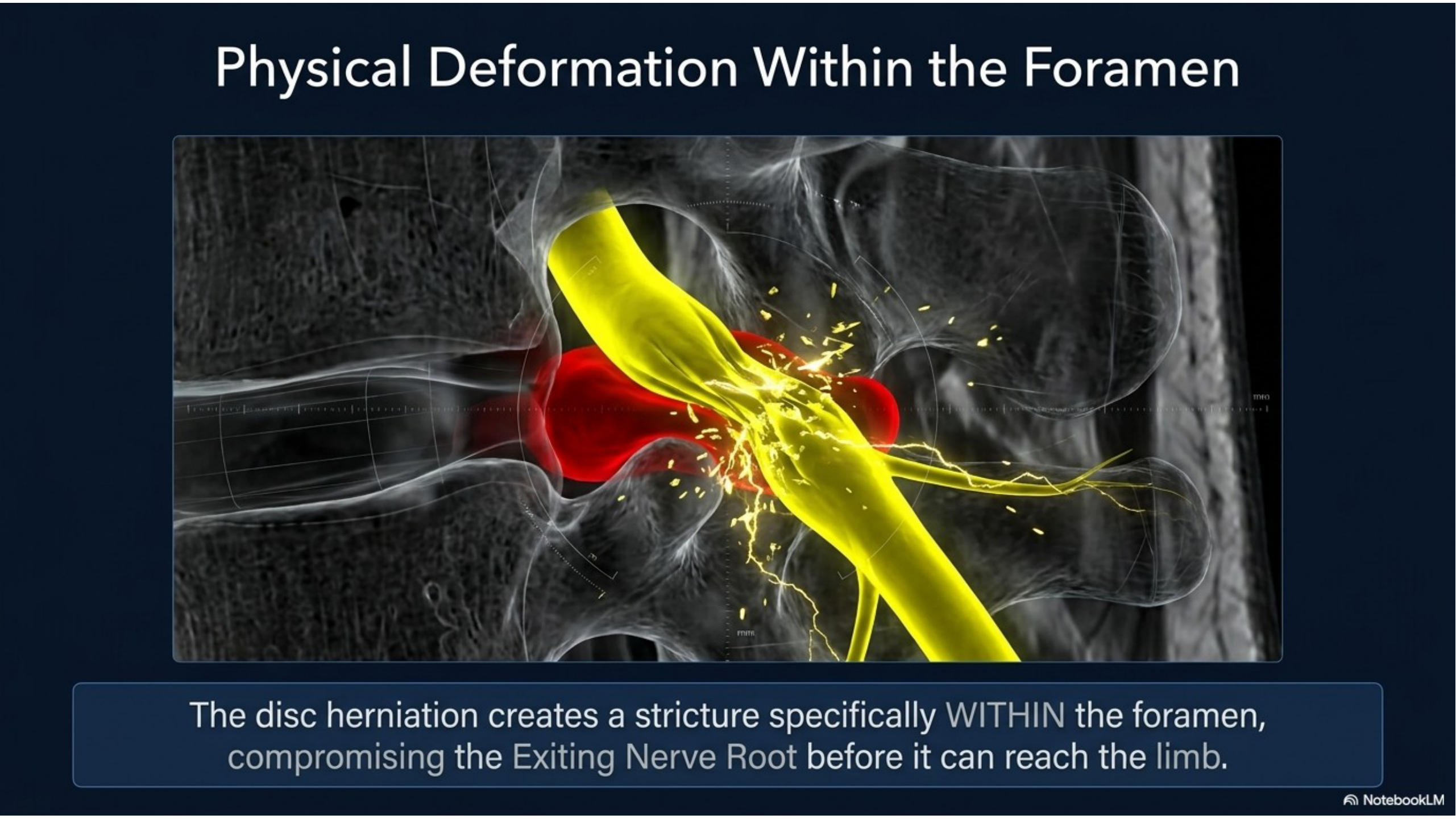
“Pinched nerve” is not a diagnosis – it is a symptom. The nerve is being compressed by something: a herniated disc, a bone spur, a swollen joint, a tight muscle, or a narrowed spinal canal. The treatment depends entirely on what is doing the compressing. Getting the wrong treatment for the wrong cause will not help – and could make it worse. That’s why accurate diagnosis matters more than anything else when nerve symptoms are involved.
Common Pinched Nerve Presentations
Cervical Radiculopathy (Neck)
Nerve compression in the neck from C5-C7 causes pain, numbness, or weakness into the shoulder, arm, and hand. Often mistaken for carpal tunnel or shoulder problems.
Lumbar Radiculopathy (Lower Back)
L4-S1 nerve compression causes sciatica – pain that radiates from the lower back into the buttock, thigh, and down the leg. May include foot numbness or weakness.
Disc Herniation Nerve Compression
A herniated disc material pressing on a nerve root produces sharp, burning, or shooting pain along the nerve’s pathway. We review MRI to confirm disc involvement.
Foraminal Stenosis
Narrowing of the openings where nerve roots exit the spine. Often develops gradually with age and causes chronic arm or leg symptoms.
Thoracic Nerve Involvement
Mid-back nerve compression causes chest wall pain, rib pain, and sometimes symptoms that mimic cardiac or abdominal conditions.
Post-Accident Nerve Irritation
Whiplash and car accident trauma can inflame nerve roots without structural compression – producing nerve symptoms that may not show on standard imaging.
Fellowship-Trained. Rarely Matched.
Our doctors hold the FSBT designation – Fellowship in Spinal Biomechanics and Trauma. This post-doctoral training is pursued by a small fraction of chiropractors and equips our team with advanced expertise in spinal imaging, ligament injury assessment, and trauma biomechanics. You get a level of analysis that most chiropractic clinics simply cannot offer.
Frequently Asked Questions
Do I need an MRI for a pinched nerve?
Often yes – especially if symptoms are severe, not improving, or involve weakness. We can review your existing MRI or help you get one if needed.
How long do pinched nerve symptoms last?
It depends on the cause. Nerve inflammation from a disc injury may resolve in weeks with proper care. Structural compression from stenosis takes longer and may require additional intervention.
Will chiropractic adjustments make a pinched nerve worse?
When done correctly by someone who has reviewed your imaging, no. We do not adjust blindly. We adjust care to your specific nerve involvement.
When should I consider surgery for a pinched nerve?
Surgery is typically reserved for cases where nerve compression is causing progressive muscle weakness, bowel or bladder dysfunction, or has not responded to conservative care. We will tell you honestly if we think you need a surgical consult.
Can you review my MRI to tell me what is causing my nerve pain?
Yes – that is exactly what our free MRI review is for. Visit our Free MRI Review page to request a consultation.
Ready to Get Relief?
Call us today or request an appointment online. Same-day appointments are often available.
How we diagnose a pinched nerve
Imaging that actually shows the problem
- Motion X-ray to see segmental instability compressing the nerve
- MRI review and correlation for disc and foraminal pathology
- Neurological exam: strength, reflexes, sensation
- Orthopedic tension tests to provoke and localize
How we treat it
- Spinal decompression for disc-related nerve root compression
- Gentle mobilization of the involved segment
- Cold laser for neural inflammation
- Corrective exercise to offload the nerve
- Referral for injection or surgical consult when indicated
What our patients say
“Dr. Matt McClean did X-rays and ordered an MRI and found an impinged nerve. He carefully adjusted and his staff were very methodical about exercises and treatment.”
. Bobbi K., Google review
“Has been helping me tremendously after I was rear ended. Has referred me to other doctors to help me in the healing process and truly cares about each patient.”
. Justin O., Google review
Pinched nerve FAQ
Good question. “pinched nerve” is often used loosely for any radiating pain. True nerve root compression has specific neurological signs. Our exam and imaging tell us whether it’s neural, muscular, or referred.
Not always. For most mild cases, motion X-ray plus the exam gives us enough to plan care. MRI is ordered when symptoms don’t improve, neurological signs are present, or surgical consult may be needed.
Yes, in many cases. Non-surgical spinal decompression combined with corrective care resolves a significant percentage of disc herniation cases without surgery. About our decompression protocol.
Those are neurological signs that need careful evaluation. We test for them at every visit and adjust the care plan if they’re progressing. If we see significant motor weakness, we refer out for urgent consultation.
Varies widely. Simple cases: 4-6 weeks. Disc herniation with radiating pain: often 8-12 weeks. Severe or long-standing cases: longer. We’ll give you a specific estimate after the exam.
Progressive neurological deficit, cauda equina symptoms, or failure of appropriate conservative care over 8-12 weeks. We have spine surgeons we work with and refer to when that’s the right call.
Pinched nerve? Let's find out what's actually compressed.
Same-week appointments available. Insurance accepted. Let’s get you a real evaluation and a plan.
McClean Chiropractic · 385 N 500 W, Provo UT 84601
Clinical Evidence
LEGORRETA AP, ET AL., 2004
Comparative analysis of individuals with chiropractic coverage showed lower costs and utilization for musculoskeletal conditions including nerve compression syndromes.
PERLE SM, KAWCHUK GN., 2005
Pressures generated during spinal manipulation and their association with hand placement support the precision and safety of chiropractic technique.
PAIGE NM, ET AL., 2017
Association of spinal manipulative therapy with clinical benefit for acute low back pain: systematic review and meta-analysis confirmed significant pain reduction.
References
- Legorreta AP, et al. Comparative analysis of individuals with and without chiropractic coverage: patient characteristics, utilization, and costs. Arch Intern Med. 2004;164(18):1985-92.
- Perle SM, Kawchuk GN. Pressures generated during spinal manipulation and their association with hand placement. J Manipulative Physiol Ther. 2005;28(4):e1-7.
- Paige NM, et al. Association of spinal manipulative therapy with clinical benefit and harm for acute low back pain: systematic review and meta-analysis. JAMA. 2017;317(14):1451-60.
Related at McClean Chiropractic