Herniated Disc Treatment in Provo, Utah
Advanced diagnostics and non-surgical spinal care — serving Utah County since 1965.
Most herniated discs can be treated without surgery. For the majority of patients, conservative care – spinal decompression, targeted chiropractic treatment, and Class IV laser therapy guided by fellowship-trained doctors – helps many patients improve over several weeks. Your exam and MRI tell us what to expect in your case. The essential first step is an accurate diagnosis that identifies which disc is involved and whether you are a candidate for non-surgical care.
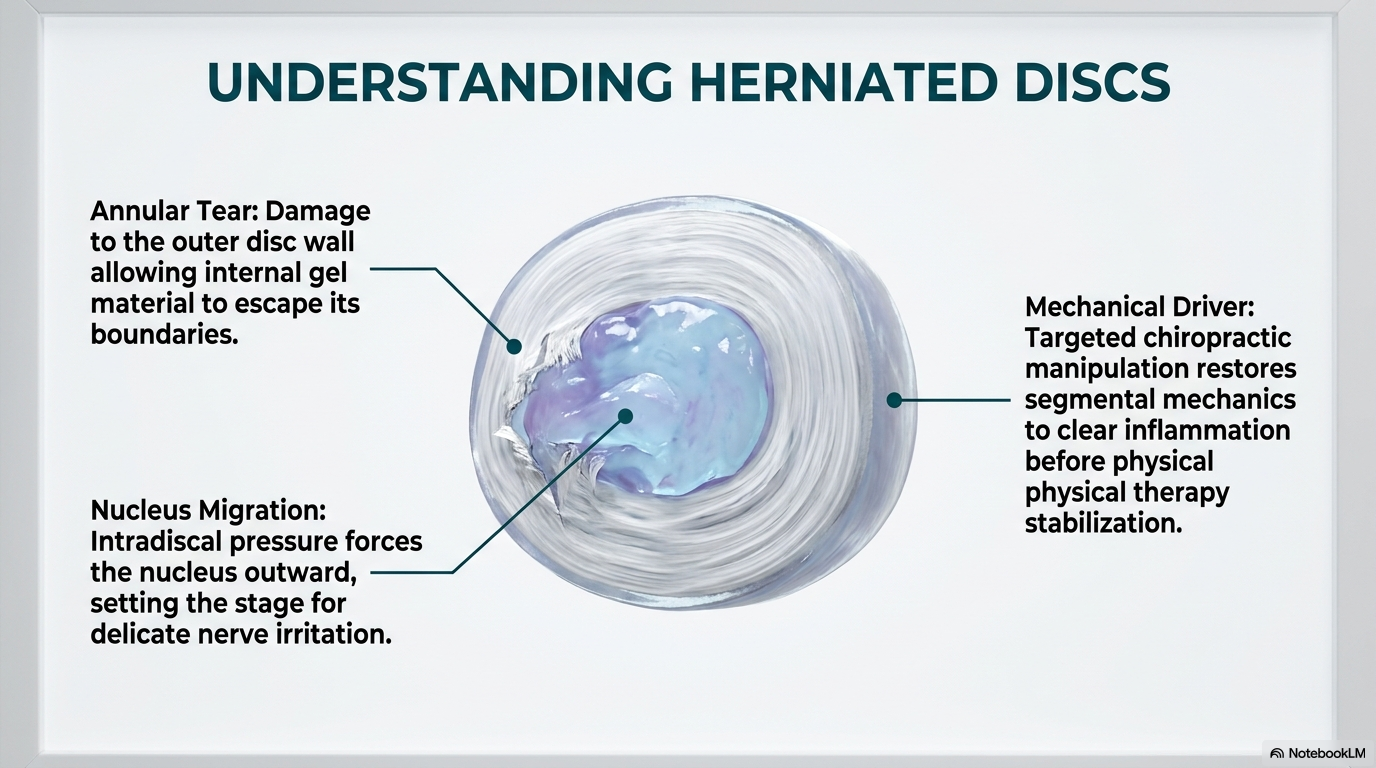
What Is a Herniated Disc?
A herniated disc occurs when the soft inner nucleus of an intervertebral disc pushes through a tear in the tougher outer annulus fibrosus. Depending on the location and direction of the herniation, it can compress nerve roots or the spinal cord, producing pain, numbness, tingling, or weakness that may radiate into the arms or legs.
Disc herniations most commonly occur at L4-L5 and L5-S1 in the lumbar spine (causing sciatica) and C5-C6 and C6-C7 in the cervical spine (causing arm pain and weakness). Most resolve without surgery when the underlying mechanical cause is identified and treated.
Our Approach to Herniated Disc Treatment
Motion X-Ray Evaluation
Dynamic fluoroscopic imaging shows how individual spinal segments move under load — identifying the exact level of herniation and any associated ligament instability that static imaging misses.
Spinal Decompression
Spinal decompression is an established conservative treatment for disc-related symptoms with clinical support in the peer-reviewed literature. It is applied based on your specific examination findings and imaging, as part of an individualized care plan. Sessions run approximately 15 minutes.
Chiropractic Adjustments
Targeted spinal manipulation restores segmental motion, reduces mechanical loading on the affected disc, and resets the neurological signaling patterns that drive central sensitization and chronic pain.
Surgery, injections or conservative care: how we help you decide
Most herniated discs never need surgery, and large studies (including the SPORT trial cited below) found that many patients who chose non-surgical care did about as well over time. But some people do need a surgeon, and quickly. We read your MRI images ourselves, not just the report, match them to your exam, and give you a straight answer:
- Good fit for non-surgical care: pain with or without leg or arm symptoms, normal or stable strength, and no bowel or bladder changes.
- Needs a specialist now: worsening weakness, foot drop, numbness in the groin, or bowel or bladder changes.
- In between: we will tell you what we would watch for and when to re-check.
Already have an MRI? Send it for a free review. If decompression fits your case, here is how it works.
Fellowship-Level Disc Expertise
Drs. McClean hold the Fellowship in Spinal Biomechanics and Trauma (FSBT) — one of the most advanced post-doctoral designations in chiropractic, covering MRI interpretation, disc biomechanics, and trauma analysis at a level not taught in standard chiropractic education.
They read the actual imaging series — not just the radiologist’s report — and use AI-assisted analysis tools to identify disc herniation characteristics, nerve compression, and instability patterns that inform the treatment plan.
Frequently Asked Questions
Can a chiropractor help a herniated disc?
Yes – for most patients, a herniated disc responds well to non-surgical chiropractic care. The key is an accurate diagnosis: our fellowship-trained doctors read your imaging themselves and use motion X-ray to confirm which disc is involved and whether spinal decompression, targeted adjustments, or laser therapy is the right approach for your case. Chiropractic is not appropriate for every herniation, which is exactly why the evaluation comes first.
Can a herniated disc heal without surgery?
Yes. Research consistently shows that most lumbar disc herniations resolve with conservative care over 6 to 12 weeks. Surgery is warranted when progressive neurological deficits are present or when conservative treatment has failed. Most patients avoid surgery entirely with proper biomechanical evaluation and treatment.
Is chiropractic treatment safe for a herniated disc?
When it follows a proper diagnostic workup, yes. Treatment is tailored to your specific herniation – we do not use a one-size-fits-all technique. For disc patients we often rely on gentle spinal decompression rather than forceful manipulation, and our fellowship training in disc biomechanics means we recognize the red flags that call for advanced imaging or a surgical referral before starting care.
Should I get an MRI before coming in?
MRI is helpful but not required to start care. If you already have imaging, bring it – we can review it as part of your consultation. Motion X-ray provides information about dynamic instability that MRI cannot show, and is often performed as part of our diagnostic workup.
How many visits will I need?
We evaluate your response to care and adjust accordingly – there is no fixed treatment protocol. Sessions are approximately 15 minutes. We check your response every few visits and change the plan if you are not improving as expected.
Clinical Evidence
Saal & Saal, 1989
A landmark study of patients with a lumbar disc herniation and nerve symptoms treated without surgery found that 90% of the 52 patients followed up had good or excellent results, and 92% returned to work. It supports conservative care as the first step for most disc herniations with nerve involvement.
Bronfort et al., 2004
A systematic review and best-evidence synthesis in Spine Journal found spinal manipulation effective for acute and chronic low back pain, with evidence comparable to first-line medical treatments including analgesics and physical therapy.
Weinstein et al., 2006 (SPORT)
The SPORT randomized trial in JAMA followed patients who were candidates for disc surgery. Both the surgery and non-surgery groups improved substantially over two years, and in the intent-to-treat analysis the differences between them were not statistically significant.
References
- Saal JA, Saal JS. Nonoperative treatment of herniated lumbar intervertebral disc with radiculopathy. Spine. 1989;14(4):431-437.
- Bronfort G, Haas M, Evans RL, Bouter LM. Efficacy of spinal manipulation and mobilization for low back pain and neck pain: a systematic review and best evidence synthesis. Spine J. 2004;4(3):335-356.
- Weinstein JN, et al. Surgical vs nonoperative treatment for lumbar disk herniation: the Spine Patient Outcomes Research Trial (SPORT): a randomized trial. JAMA. 2006;296(20):2441-2450.
Schedule Your Consultation Today
Fellowship-trained spine specialists serving Provo and all of Utah County.
A complete non-surgical option for disc injuries
Our Disc Recovery Program combines spinal decompression and Class IV laser therapy, guided by fellowship-trained doctors who read your MRI themselves. If your herniated disc is coming from a disc problem, this is the structured way to treat it without surgery.
Related Spine Conditions We Treat
Fellowship-trained care across Provo & Utah County. Explore related conditions:
Treated the disc? Now protect it.
Most re-herniations happen because the deep stabilizing muscles never relearned their job after the injury. Our computerized spine stability program measures your stability, symmetry, and endurance on biofeedback exercise machines designed and built in our clinic, then retrains the weak links so your disc stays protected.
More From Our Spine Education Library
Articles from our fellowship-trained doctors on the topics above: