Dizziness and Off-Balance Symptoms After a Car Accident
Provo, Utah — Cervicogenic Dizziness. Upper Cervical Instability. Fellowship Evaluation.
Dizziness following a car accident is common and often alarming. In the context of a whiplash injury, dizziness is usually cervicogenic — originating from disrupted proprioceptive signaling in the upper cervical spine — rather than from a head injury. The distinction has important treatment implications.
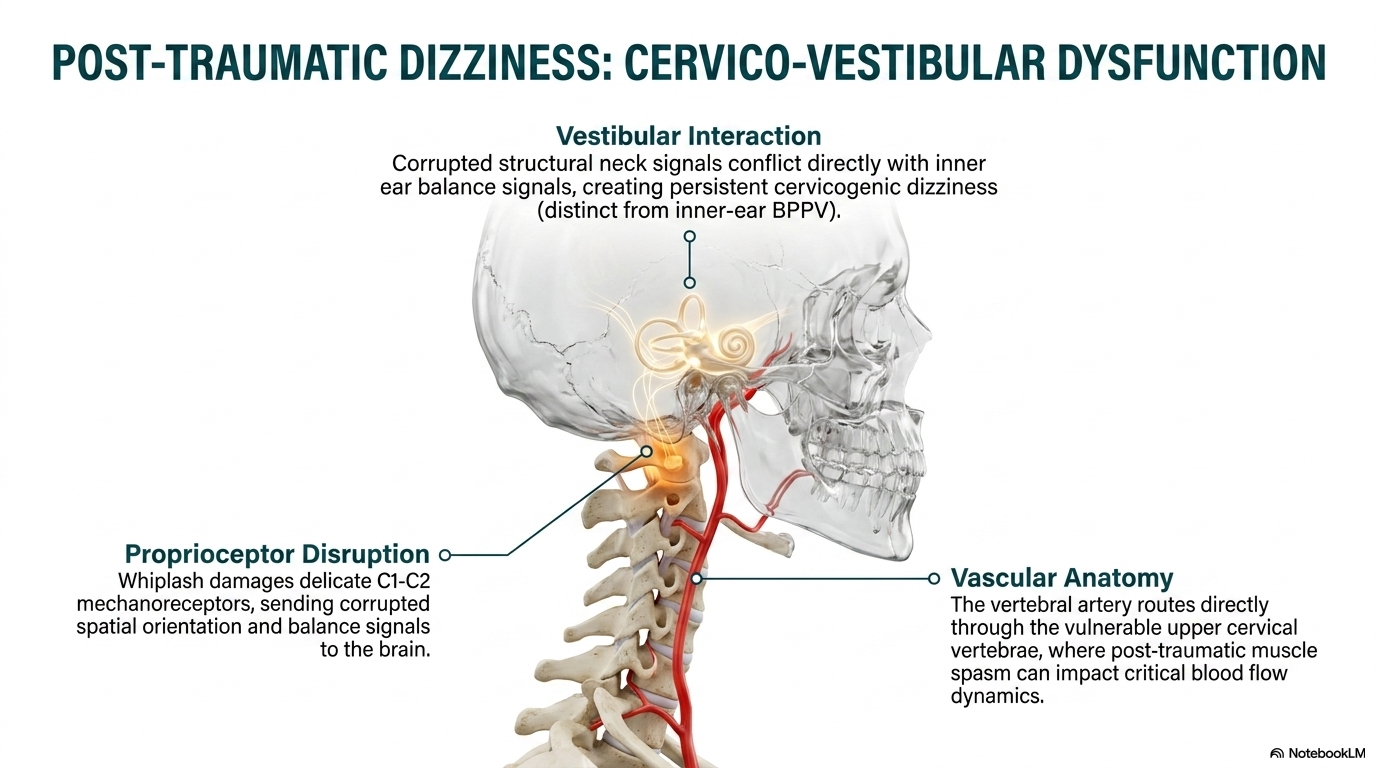
Why the Cervical Spine Causes Dizziness
The upper cervical spine — particularly the joints at C1-C2 — contains an exceptionally high density of proprioceptors. These mechanoreceptors constantly transmit position and motion information to the brain and cerebellum, which use this data to maintain balance and spatial orientation. When the upper cervical ligaments and joints are injured in a car accident, the proprioceptive signal from these sensors becomes abnormal or noisy. The brain receives conflicting information from the neck versus the inner ear and eyes, producing dizziness, unsteadiness, and difficulty with gaze stability.
This is called cervicogenic dizziness — and it is common after whiplash injury. It is distinct from concussion (though they can coexist), and it is distinct from BPPV (benign paroxysmal positional vertigo), which has a different mechanism and presentation. Identifying which type of dizziness is present is essential for directing appropriate treatment.
Upper Cervical Instability and the Autonomic Nervous System
In more significant upper cervical injuries, ligament instability at the C1-C2 level can affect the vertebral arteries that pass through the transverse foramina of the upper cervical vertebrae. Motion X-ray can identify the degree of C1-C2 instability and whether head position or movement correlates with symptom provocation — an important safety evaluation before treatment begins.
Symptoms and Signs
Cervicogenic Dizziness
- Dizziness triggered by neck movement
- Unsteadiness when walking
- Difficulty with eye tracking
- Associated neck pain
BPPV (Inner Ear)
- Sudden spinning sensation
- Triggered by lying down or rolling
- Brief episodes (seconds)
- Nausea with severe episodes
Seek Immediate Care If:
- Sudden severe headache
- Slurred speech or vision loss
- Facial drooping
- Dizziness with arm/leg weakness
Fellowship-Level Trauma Evaluation
Our doctors hold a Fellowship in Spinal Biomechanics and Trauma (FSBT) — one of the highest post-doctoral credentials available in chiropractic, including advanced training in trauma evaluation, MRI interpretation, and motion X-ray analysis. We have been serving Utah County since 1999 and work directly with personal injury attorneys, local MRI facilities, and spine specialists.
If you were in a car accident, your injury documentation begins on day one. The longer you wait, the harder it is to establish a clear relationship between the collision and your injuries. We can evaluate you, document the clinical findings thoroughly, and coordinate with your attorney and insurance carrier.
Dizziness and Off-Balance Symptoms After a Car Accident
Research on Cervicogenic Dizziness After Whiplash
Dizziness and balance problems following a car accident are frequently attributed to inner-ear injury. Research consistently identifies the upper cervical spine — specifically disrupted proprioceptive signaling from C1-C3 — as the primary source in most post-collision cases.
Treleaven (2008) — Cervicogenic Dizziness Review
A comprehensive systematic review established that cervicogenic dizziness — dizziness originating from neck proprioceptors — is a well-documented clinical entity following whiplash, distinct from vestibular causes, and responsive to cervical manual therapy and specific sensorimotor rehabilitation.
Panjabi — Cervical Proprioception & Instability
Research on cervical mechanoreceptors established that whiplash injury disrupts the proprioceptive feedback from upper cervical ligaments and facet capsules — producing mismatch between cervical, vestibular, and visual input that the brain interprets as dizziness and disequilibrium.
Reid & Rivett — Manual Therapy for Cervicogenic Dizziness
A Cochrane-reviewed study found that manual therapy directed at the upper cervical spine produced significant reduction in dizziness frequency and intensity in patients with cervicogenic dizziness — with effects superior to vestibular rehabilitation alone when the cervical component was present.
References
- Treleaven J. Sensorimotor disturbances in neck disorders affecting postural stability, head and eye movement control. Man Ther. 2008;13(1):2-11.
- Panjabi MM. The stabilizing system of the spine. Part I. Function, dysfunction, adaptation, and enhancement. J Spinal Disord. 1992;5(4):383-389.
- Reid SA, Rivett DA. Manual therapy treatment of cervicogenic dizziness: a systematic review. Man Ther. 2005;10(1):4-13.
Related Car Accident Injuries
Our Diagnostics
Get a Complete Evaluation — Not Just a Basic Exam
Serving Provo, Orem, Springville, Mapleton, Vineyard, Spanish Fork, and all of Utah County