Whiplash After a Car Accident
Provo, Utah — Fellowship-Level Diagnosis. Motion X-Ray. Ligament Injury Documentation.
Whiplash is the most common injury from a rear-end or side-impact collision. It is also the most mismanaged. Emergency room X-rays are almost always read as normal — because standard X-rays cannot show ligament damage. That doesn’t mean the ligaments are intact.
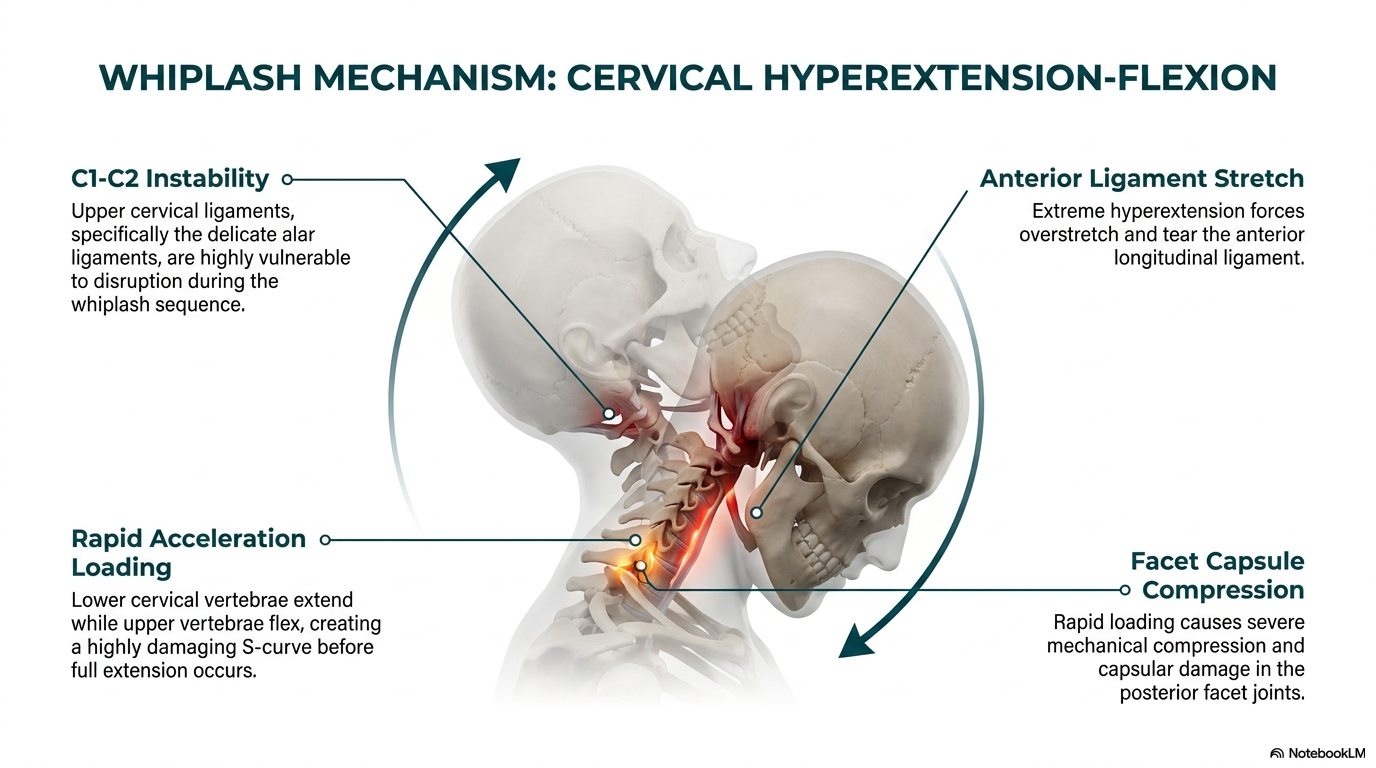
What Is Whiplash?
Whiplash is a hyperextension-flexion injury to the cervical spine — the neck accelerates violently in one direction (typically rearward in a rear-end collision) and then rebounds in the opposite direction faster than the muscles can protect it. The resulting forces stretch the ligaments, facet joint capsules, intervertebral discs, and surrounding musculature beyond their physiological range.
The cervical spine’s ligaments are its primary passive stabilizers. When ligaments are stretched or torn, they do not regenerate to the same tensile strength. The result is segmental hypermobility — a joint that moves more than it should at that level, compensated by adjacent segments that are now overloaded. This mechanical instability pattern persists indefinitely without treatment and is often the cause of chronic neck pain, headaches, and cognitive symptoms that follow unresolved whiplash.
Why the ER Said You Were Fine
Standard X-rays show bone. They do not show ligaments. An emergency room evaluation for whiplash will rule out fracture — a critical and appropriate first step. But ruling out fracture does not rule out ligament injury. Motion X-ray (video fluoroscopy) evaluates the cervical spine in motion — showing how each segment moves and whether any segment is hypermobile, restricted, or unstable. This is the evaluation that determines whether a ligament injury is present and at which level. We are fellowship-trained in this evaluation and it is not available at most clinics in Utah County.
Symptoms and Signs
Immediate Symptoms
- Neck pain and stiffness
- Shoulder or upper back pain
- Headache at base of skull
- Dizziness
Delayed Symptoms (24–72 hrs)
- Worsening neck stiffness
- Arm pain or tingling
- Jaw pain (TMJ involvement)
- Difficulty concentrating
Chronic (If Untreated)
- Chronic neck pain
- Recurring headaches
- Brain fog
- Spinal instability patterns
Fellowship-Level Trauma Evaluation
Our doctors hold a Fellowship in Spinal Biomechanics and Trauma (FSBT) — one of the highest post-doctoral credentials available in chiropractic, including advanced training in trauma evaluation, MRI interpretation, and motion X-ray analysis. We have been serving Utah County since 1999 and work directly with personal injury attorneys, local MRI facilities, and spine specialists.
If you were in a car accident, your injury documentation begins on day one. The longer you wait, the harder it is to establish a clear relationship between the collision and your injuries. We can evaluate you, document the clinical findings thoroughly, and coordinate with your attorney and insurance carrier.
Whiplash After a Car Accident
Whiplash causes or contributes to: neck pain, headaches, shoulder pain, TMJ dysfunction, cervical disc herniation, and spinal instability. See our pages on neck pain, headaches, and motion X-ray evaluation.
What the Research Shows About Whiplash Injury
Whiplash is not a soft-tissue sprain that heals in weeks. Peer-reviewed biomechanical studies demonstrate measurable structural injury to cervical ligaments, facet capsules, and discs — injuries that can produce chronic pain when missed or undertreated.
Panjabi et al. — Ligament Injury in Whiplash
Cadaveric biomechanical studies demonstrated that rear-end impacts at low speeds can stretch and tear cervical alar and capsular ligaments beyond their physiological limit — injuries invisible on standard X-ray and MRI.
Lord et al. (1996) — Cervical Facet Pain Prevalence
In a landmark New England Journal of Medicine study, cervical zygapophyseal (facet) joint pain was identified as the most common source of chronic neck pain following whiplash — present in 54% of patients with persistent symptoms.
Quebec Task Force on Whiplash (1995)
The comprehensive Quebec Task Force monograph established the WAD (Whiplash-Associated Disorder) grading system still used clinically today, and documented that delayed symptom onset — days after the crash — is a normal and expected pattern of cervical soft-tissue injury.
References
- Panjabi MM, Cholewicki J, Nibu K, Babat LB, Dvorak J. Simulation of whiplash trauma using whole cervical spine specimens. Spine. 1998;23(1):17-24.
- Lord SM, Barnsley L, Wallis BJ, McDonald GJ, Bogduk N. Percutaneous radio-frequency neurotomy for chronic cervical zygapophyseal-joint pain. N Engl J Med. 1996;335(23):1721-1726.
- Spitzer WO, Skovron ML, Salmi LR, et al. Scientific monograph of the Quebec Task Force on Whiplash-Associated Disorders. Spine. 1995;20(8 Suppl):1S-73S.
Related Car Accident Injuries
Our Diagnostics
Get a Complete Evaluation — Not Just a Basic Exam
Serving Provo, Orem, Springville, Mapleton, Vineyard, Spanish Fork, and all of Utah County