Neck Pain After a Car Accident
Provo, Utah — Cervical Spine Specialists. Motion X-Ray. Fellowship-Level Evaluation.
Neck pain after a car accident is not the same as general neck pain. The mechanism of injury is distinct, the ligament structures at risk are specific, and the diagnostic evaluation that reveals the true extent of injury is different from a standard neck pain workup.
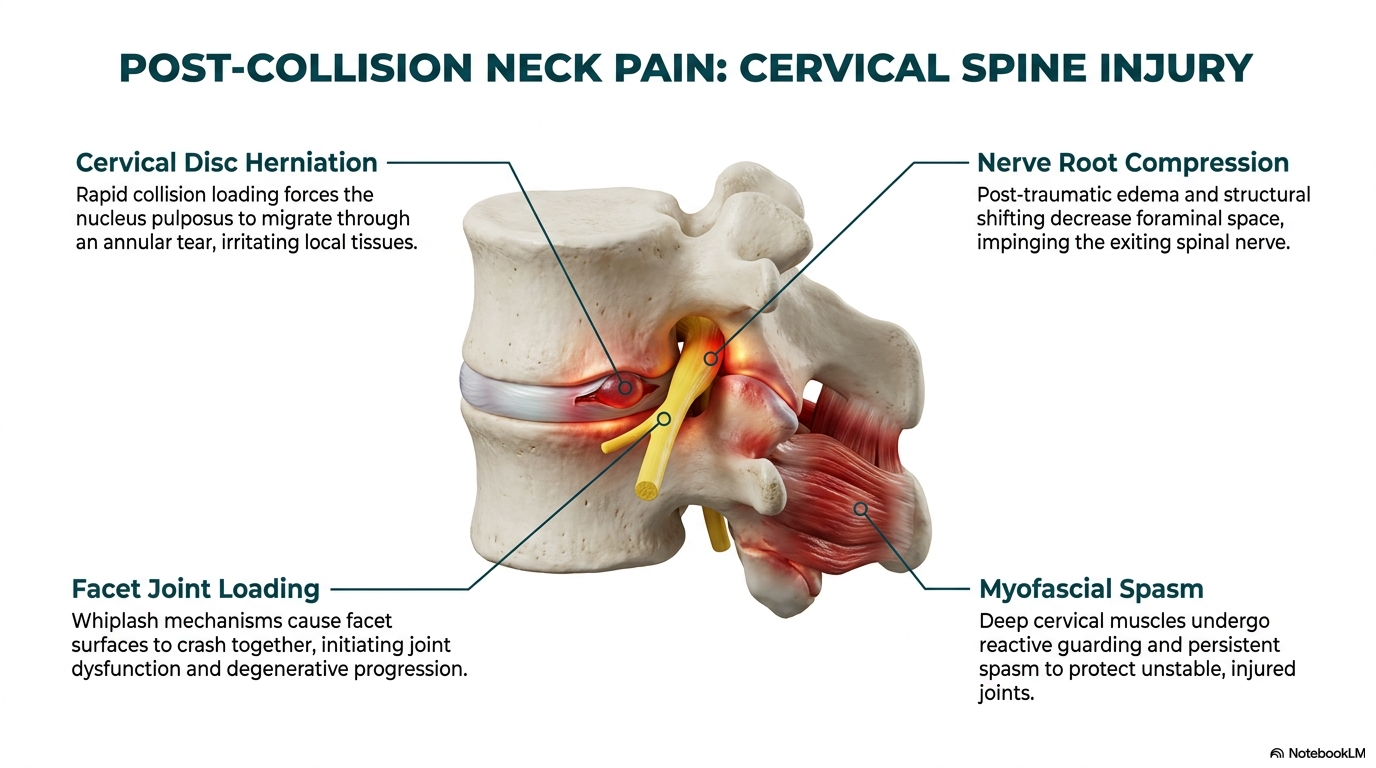
Why Car Accident Neck Pain Is Different
A collision produces a rapid acceleration-deceleration force that moves the head and neck faster than voluntary muscle activation can protect. This loads the cervical facet joints, discs, ligaments, and muscles at force levels they are not designed to handle. The facet joint capsules — small, highly innervated structures at each spinal level — are particularly vulnerable to this type of loading and are a primary source of post-accident neck pain.
The cervical ligaments (anterior longitudinal ligament, posterior longitudinal ligament, alar ligaments, transverse ligament) stabilize the cervical spine passively. When they are overstretched during a collision, they do not appear on standard X-ray or even on standard MRI. The injury shows up as segmental hypermobility on motion X-ray — a segment that translates or rotates more than its normal range during flexion-extension. This finding is objective, documentable, and directly relevant to treatment and prognosis.
What Our Evaluation Includes
Standard chiropractic evaluations after a car accident typically involve static X-rays and orthopedic testing. Our fellowship-trained evaluation includes spinal biomechanical analysis of each cervical segment, motion X-ray when ligament instability is suspected, and review of any existing MRI imaging — not just the radiologist’s report. We document the injury pattern thoroughly, which is also relevant for personal injury documentation if you are working with an attorney.
Symptoms and Signs
Cervical Facet Symptoms
- Pain with head rotation
- Stiffness in the morning
- Pain referring to shoulder
- Pain worsened by extension
Disc/Nerve Symptoms
- Arm pain or weakness
- Numbness into fingers
- Pain with certain movements
- Sharp pain with compression
Muscle/Soft Tissue
- Muscle spasm and guarding
- Trigger points in trapezius
- Difficulty turning head
- Neck pain with eye movement
Fellowship-Level Trauma Evaluation
Our doctors hold a Fellowship in Spinal Biomechanics and Trauma (FSBT) — one of the highest post-doctoral credentials available in chiropractic, including advanced training in trauma evaluation, MRI interpretation, and motion X-ray analysis. We have been serving Utah County since 1999 and work directly with personal injury attorneys, local MRI facilities, and spine specialists.
If you were in a car accident, your injury documentation begins on day one. The longer you wait, the harder it is to establish a clear relationship between the collision and your injuries. We can evaluate you, document the clinical findings thoroughly, and coordinate with your attorney and insurance carrier.
Neck Pain After a Car Accident
Neck pain after a car accident often involves: whiplash, headaches, spinal instability, and radiating nerve pain.
Research on Post-Collision Cervical Injury
Neck pain after a car accident is not simply muscle soreness. Research identifies specific structural injury patterns — facet joint loading, disc disruption, and ligament laxity — that require targeted clinical evaluation to diagnose and treat.
Barnsley et al. — Facet Joints as Pain Source
Controlled diagnostic blocks demonstrated cervical facet joints as a primary pain generator in 54-60% of chronic post-whiplash neck pain patients — far more prevalent than typically recognized in standard emergency evaluations.
Yoganandan et al. — Cervical Disc Injury Biomechanics
Biomechanical testing confirmed that the cervical disc is susceptible to annular disruption during the hyperextension-flexion whiplash sequence — injuries that may not appear on initial MRI but produce chemical irritation of adjacent nerve roots.
Cote et al. — Prognosis of Whiplash Neck Pain
Longitudinal research found that patients who received early active treatment — including spinal manipulation — recovered faster and were significantly less likely to develop chronic neck pain than those managed with rest and collars alone.
References
- Barnsley L, Lord SM, Wallis BJ, Bogduk N. The prevalence of chronic cervical zygapophysial joint pain after whiplash. Spine. 1995;20(1):20-26.
- Yoganandan N, Pintar FA, Cusick JF. Biomechanical analyses of whiplash injuries using an animal model. Accid Anal Prev. 2002;34(1):69-79.
- Cote P, Cassidy JD, Carroll L. The treatment of neck and low back pain: who seeks care? who goes where? Med Care. 2001;39(9):956-967.
Related Car Accident Injuries
Our Diagnostics
Get a Complete Evaluation — Not Just a Basic Exam
Serving Provo, Orem, Springville, Mapleton, Vineyard, Spanish Fork, and all of Utah County