Spinal Instability and Ligament Injury After a Car Accident
Provo, Utah — Motion X-Ray Diagnosis. Ligament Laxity. Fellowship Trauma Evaluation.
Ligament injuries from car accidents are the most under-diagnosed spinal injuries in emergency and primary care. They do not appear on X-ray. They are frequently missed on MRI. But they are the primary cause of chronic instability, recurring pain, and long-term disability following motor vehicle collisions.
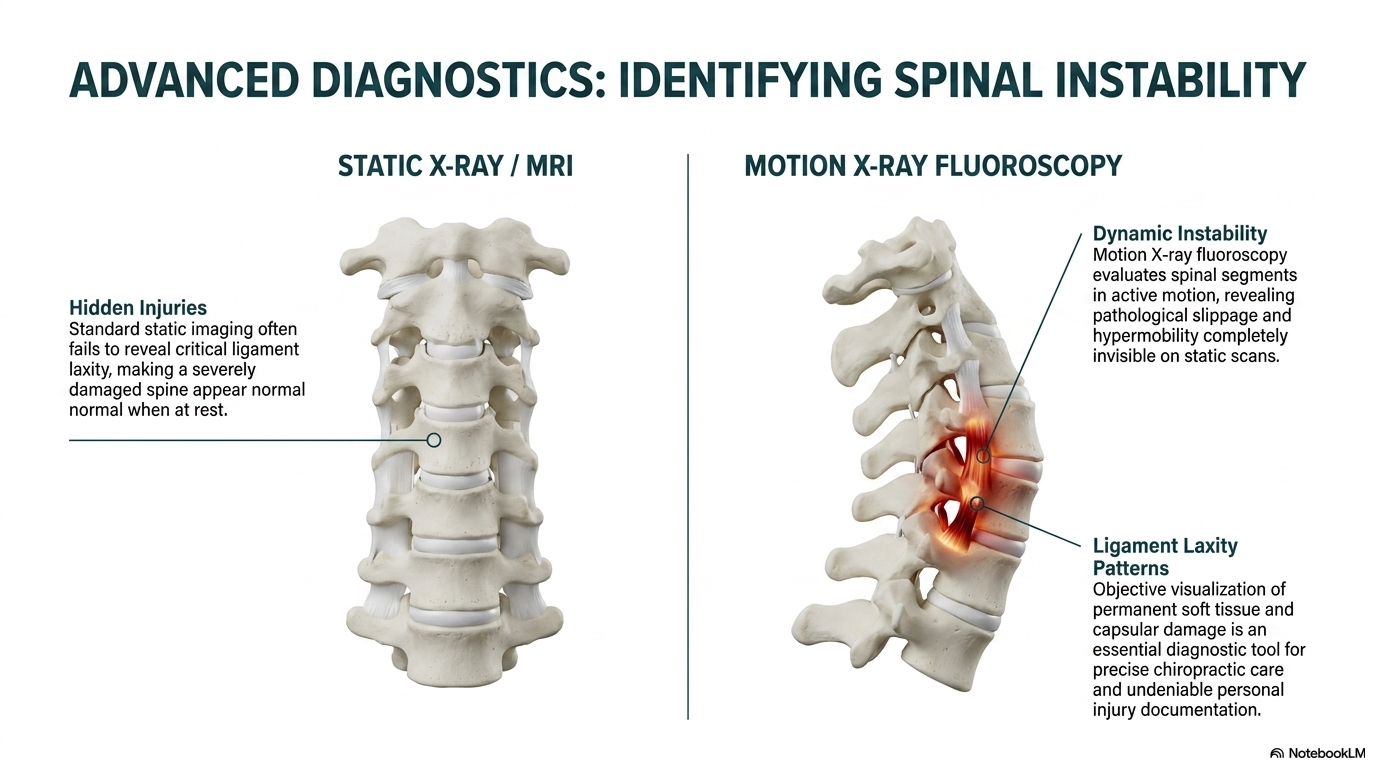
How Ligaments Are Injured in a Collision
Spinal ligaments are the passive stabilizers of the spine — they limit excessive motion at each spinal segment without requiring muscle activation. In a car accident, the rapid acceleration-deceleration forces move the spine through a range that exceeds ligament tensile strength, causing micro-tears or complete ruptures. Unlike bone, ligaments do not reliably heal to their original length and tensile strength. A ligament that was stretched in a collision may remain lax, allowing the segment above and below it to move more than its physiological range indefinitely.
The cervical spine is most vulnerable due to the head’s mass and its position at the end of the kinetic chain. The alar ligaments, transverse ligament, and posterior longitudinal ligament are particularly at risk in high-speed collisions. The atlantoaxial complex (C1-C2) is especially important — instability here can have significant neurological implications.
Motion X-Ray: The Only Test That Reveals Ligament Instability
Standard X-ray and MRI are taken with the patient in a static, resting position. A ligament injury that produces instability only shows up when the spine is in motion — flexion, extension, lateral bending. Motion X-ray (video fluoroscopy) records the cervical and lumbar spine through a full range of motion in real time. Any segment that translates or rotates beyond its normal physiological range is objectively documented on the study.
Our fellowship-trained doctors are certified in motion X-ray interpretation. We perform and read our own studies — this is not sent to a radiologist unfamiliar with dynamic biomechanical analysis. The findings are quantified using standardized measurements and documented in a clinical report that is legally relevant in personal injury cases.
Symptoms and Signs
Signs of Cervical Instability
- Neck “giving way” or cracking
- Pain at end range of motion
- Feeling of needing to hold the head
- Symptoms worse with head movement
Neurological Signs
- Dizziness with head movement
- Visual disturbance
- Radiating arm or leg pain
- Difficulty with balance
Chronic Pattern
- Recurring neck or back pain
- Chronic headache pattern
- Pain that returns with activity
- Fatigue of neck muscles
Fellowship-Level Trauma Evaluation
Our doctors hold a Fellowship in Spinal Biomechanics and Trauma (FSBT) — one of the highest post-doctoral credentials available in chiropractic, including advanced training in trauma evaluation, MRI interpretation, and motion X-ray analysis. We have been serving Utah County since 1999 and work directly with personal injury attorneys, local MRI facilities, and spine specialists.
If you were in a car accident, your injury documentation begins on day one. The longer you wait, the harder it is to establish a clear relationship between the collision and your injuries. We can evaluate you, document the clinical findings thoroughly, and coordinate with your attorney and insurance carrier.
Spinal Instability and Ligament Injury After a Car Accident
Related: whiplash, motion X-ray, dizziness, car accident care.
Research on Ligamentous Instability After Motor Vehicle Collision
Spinal ligament injuries represent the most under-diagnosed consequence of motor vehicle collisions. Standard imaging misses them. The research is clear: dynamic evaluation is the only reliable way to detect ligament laxity, and untreated instability progresses to chronic pain and accelerated degeneration.
Panjabi et al. — Alar Ligament Injury in Whiplash
Cadaveric biomechanical testing demonstrated that rear-end impacts can elongate alar and transverse ligaments beyond their elastic limit — producing permanent laxity. This injury is invisible on standard static MRI and X-ray, but produces measurable hypermobility on dynamic assessment.
Kaale et al. (2005) — MRI Detection of Ligament Injury
High-resolution MRI studies found alar and transverse ligament abnormalities in 73% of whiplash patients with chronic symptoms — yet these findings are missed on standard clinical MRI reads not specifically directed at ligamentous structures. Motion X-ray remains the most clinically accessible tool for demonstrating functional instability.
Centeno et al. — Ligament Laxity and Chronic Pain
Research on cervical instability established that undetected ligamentous laxity is a primary driver of treatment-resistant neck pain — because standard therapies address symptoms without addressing the mechanical instability causing them. Early identification and stabilization-focused treatment changes outcomes significantly.
References
- Panjabi MM, Ito S, Pearson AM, Ivancic PC. Injury mechanisms of the cervical intervertebral disc during simulated whiplash. Spine. 2004;29(11):1217-1225.
- Kaale BR, Krakenes J, Albrektsen G, Wester K. Head position and impact direction in whiplash injuries: associations with MRI-verified lesions of ligaments and membranes in the upper cervical spine. J Neurotrauma. 2005;22(11):1294-1302.
- Centeno CJ, Elliott J, Elkins WL, Freeman M. Fluoroscopically guided cervical prolotherapy for instability with blinded pre and post radiographic reading. Pain Physician. 2005;8(1):67-72.
Related Car Accident Injuries
Our Diagnostics
Get a Complete Evaluation — Not Just a Basic Exam
Serving Provo, Orem, Springville, Mapleton, Vineyard, Spanish Fork, and all of Utah County