Headaches After a Car Accident
Provo, Utah — Cervicogenic Headache. Post-Traumatic Headache. Fellowship Evaluation.
Post-traumatic headache is the most common symptom following a car accident, affecting a significant majority of whiplash patients. Most post-accident headaches originate from the cervical spine — not from the brain — and respond well to treatment directed at the upper cervical segments.
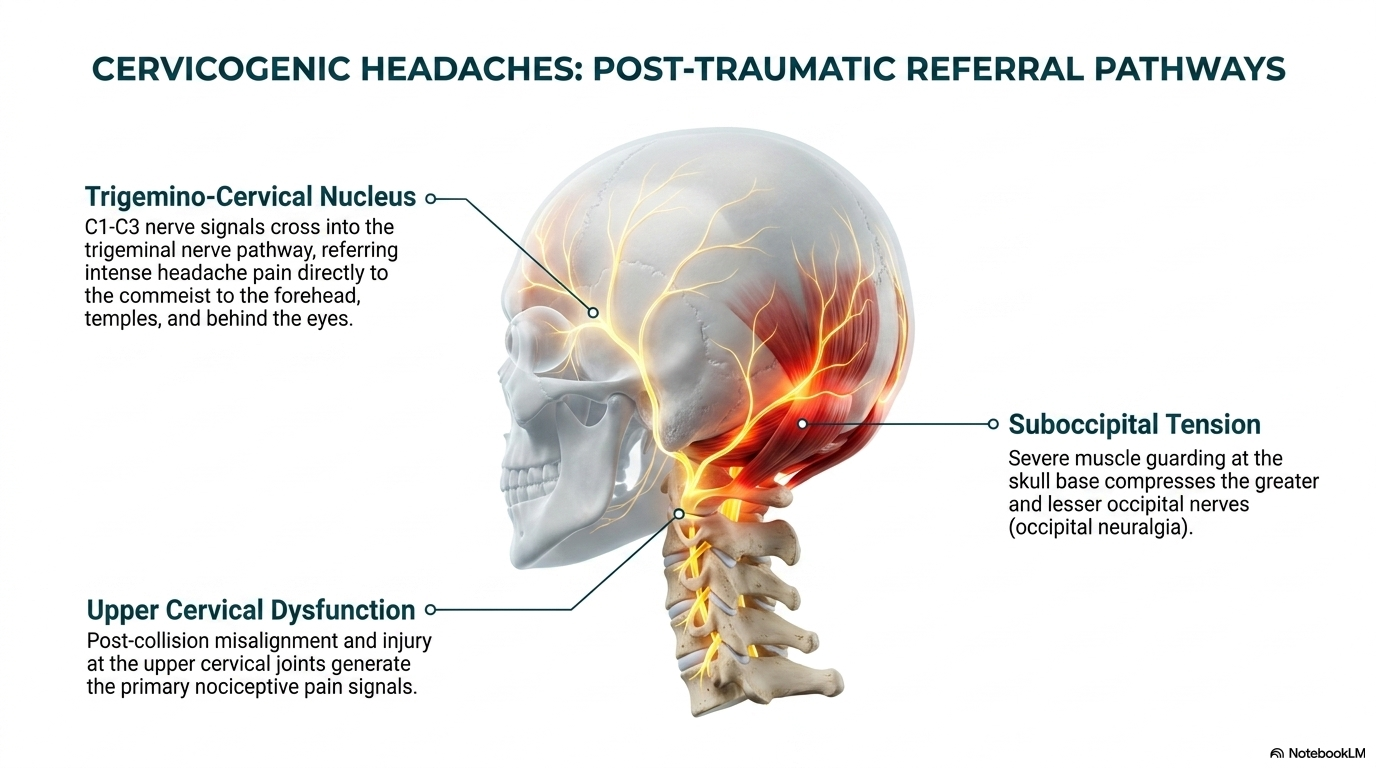
Why Car Accidents Cause Headaches
The upper cervical spine — particularly C1, C2, and C3 — shares neurological connections with the trigeminal nerve, which supplies sensation to the head and face. When the upper cervical joints and ligaments are injured in a collision, they generate afferent pain signals that are referred to the head and perceived as headache. This is called cervicogenic headache — headache originating from the neck.
Post-accident headaches may also involve: increased muscle tension in the suboccipital region (the muscles at the base of the skull), facet joint irritation at C2-C3 (a primary source of occipital headache), cervical disc disruption at upper levels, and in some cases, altered blood flow or autonomic dysfunction from upper cervical instability.
How We Evaluate and Treat Post-Accident Headache
The key question is: what is the headache’s source? A headache that starts at the base of the skull and radiates forward, worsens with specific neck movements, or is associated with neck stiffness is almost certainly cervicogenic and will respond to treatment directed at the upper cervical spine. Our evaluation includes upper cervical motion assessment, motion X-ray when instability is suspected, and specific palpation to identify the generating segment. This is more predictive of the headache’s source than most standard neurological workups.
Symptoms and Signs
Cervicogenic Headache Pattern
- Pain starting at skull base
- Radiating to forehead or eye
- Worsened by neck movement
- Associated neck stiffness
Post-Traumatic Pattern
- Constant or daily headache
- Diffuse pressure or throbbing
- Sensitivity to light and sound
- Cognitive fatigue with headache
Muscle Tension Component
- Suboccipital tightness
- Trigger points at skull base
- Headache worse after screen time
- Jaw clenching or TMJ involvement
Fellowship-Level Trauma Evaluation
Our doctors hold a Fellowship in Spinal Biomechanics and Trauma (FSBT) — one of the highest post-doctoral credentials available in chiropractic, including advanced training in trauma evaluation, MRI interpretation, and motion X-ray analysis. We have been serving Utah County since 1999 and work directly with personal injury attorneys, local MRI facilities, and spine specialists.
If you were in a car accident, your injury documentation begins on day one. The longer you wait, the harder it is to establish a clear relationship between the collision and your injuries. We can evaluate you, document the clinical findings thoroughly, and coordinate with your attorney and insurance carrier.
Headaches After a Car Accident
Post-accident headaches often co-occur with: whiplash, neck pain, TMJ dysfunction.
Research on Post-Traumatic Cervicogenic Headache
Headaches following a car accident are frequently misclassified as tension headaches or migraines. Research identifies the upper cervical spine — specifically C1-C3 — as the most common structural source, and spinal manipulation as an effective treatment.
Bogduk & Govind — Cervicogenic Headache Anatomy
The trigeminal-cervical nucleus receives convergent input from the C1, C2, and C3 nerve roots — explaining the referral of upper cervical joint pain into the forehead, eye, and temple. This anatomical pathway, the trigeminocervical complex, is the basis for cervicogenic headache diagnosis.
Nilsson et al. (1997) — Manipulation for Cervicogenic Headache
A randomized controlled trial found that spinal manipulation reduced cervicogenic headache frequency by 69% and analgesic use by 36% — outperforming soft-tissue therapy alone — supporting upper cervical chiropractic care as a first-line treatment.
Haas et al. — Dose-Response for Cervicogenic Headache
A dose-response study in the Journal of Manipulative and Physiological Therapeutics demonstrated that patients receiving higher-dose chiropractic care for cervicogenic headache showed proportionally greater reductions in headache frequency, supporting individualized care plans over standardized protocols.
References
- Bogduk N, Govind J. Cervicogenic headache: an assessment of the evidence on clinical diagnosis, invasive tests, and treatment. Lancet Neurol. 2009;8(10):959-968.
- Nilsson N, Christensen HW, Hartvigsen J. The effect of spinal manipulation in the treatment of cervicogenic headache. J Manipulative Physiol Ther. 1997;20(5):326-330.
- Haas M, Groupp E, Aickin M, et al. Dose response for chiropractic care of chronic cervicogenic headache and associated neck pain. J Manipulative Physiol Ther. 2004;27(9):547-553.
Related Car Accident Injuries
Our Diagnostics
Get a Complete Evaluation — Not Just a Basic Exam
Serving Provo, Orem, Springville, Mapleton, Vineyard, Spanish Fork, and all of Utah County