Radiating Nerve Pain, Numbness, and Tingling After a Car Accident in Provo
Provo, Utah — Radiculopathy From Car Accident. Disc Herniation. Fellowship Evaluation.
Radiating pain, numbness, or tingling in the arm or leg after a car accident indicates nerve root involvement. This is not simply soft tissue injury — it means a nerve is being compressed, irritated, or chemically sensitized, and it requires a specific evaluation to identify which nerve root and what is causing the compression.
The short answer
Radiating pain, numbness or tingling in an arm or leg after a crash usually means a nerve root is being compressed, often by a disc injury. The pattern of symptoms points to the level involved. We confirm it with the exam and imaging and treat the cause, including decompression when a disc is pressing on the nerve.
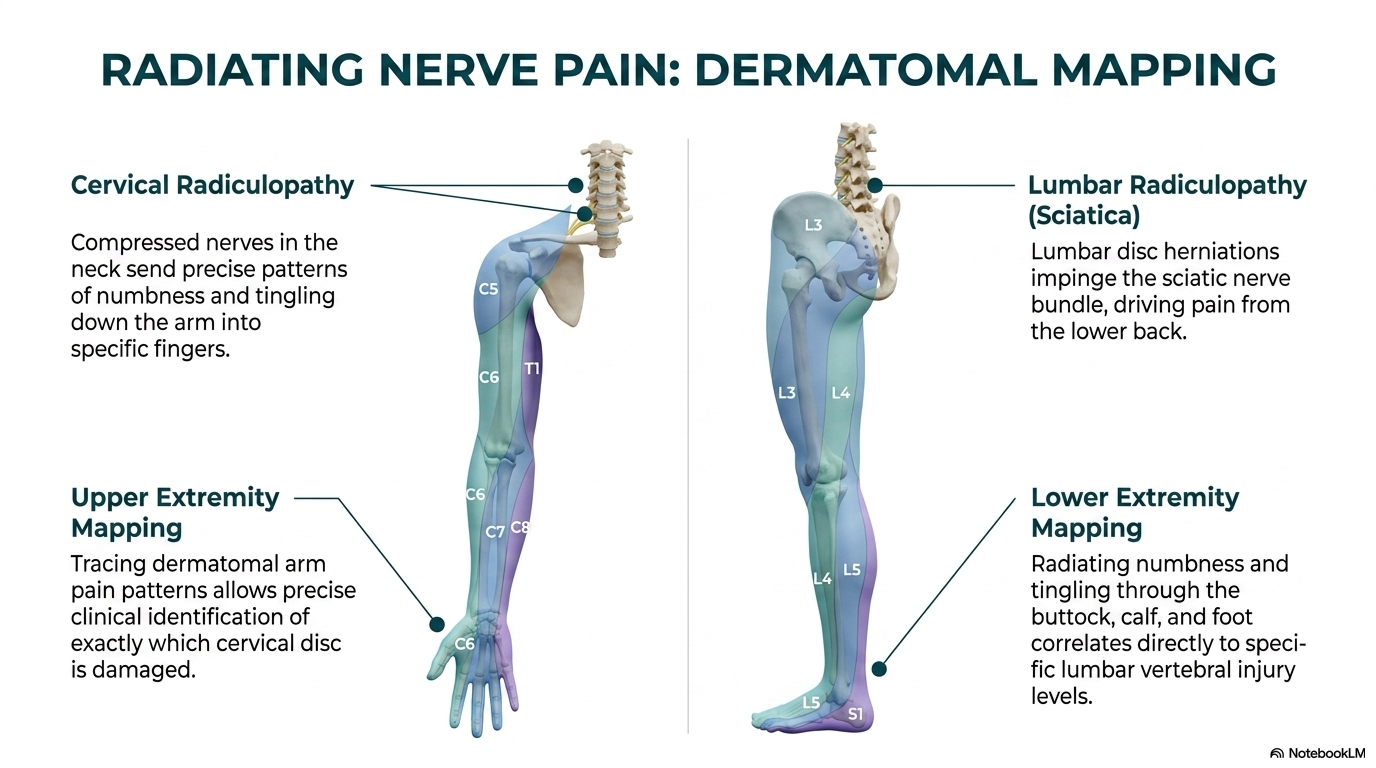
How Car Accidents Cause Nerve Pain
The rapid forces of a collision can herniate a cervical or lumbar disc, compress a nerve root in its foramen, or damage the ligaments that stabilize a spinal segment — allowing that segment to move into a position that compresses the exiting nerve. Any of these mechanisms can produce the characteristic radiating, burning, or electric pain of radiculopathy.
The pattern of numbness and tingling is diagnostically useful — the specific fingers, areas of the arm or leg affected follow dermatome maps that correlate with specific nerve roots. C6 root compression typically causes numbness in the thumb and index finger. C7 involves the middle finger. L4-L5 produces symptoms in the lateral calf and dorsal foot. This dermatomal pattern, combined with imaging, allows us to precisely identify which level is involved.
Why This Needs More Than Rest
Nerve root compression does not resolve spontaneously in most cases. The mechanical pressure or disc herniation causing the compression must be addressed. At our clinic, this means identifying the level with precise evaluation, restoring mechanical integrity to the segment, and applying decompression if a disc herniation is contributing to the nerve compression. Early treatment significantly improves outcomes — the longer a nerve root remains compressed, the greater the risk of persistent numbness and weakness.
Symptoms and Signs
Cervical Nerve Root (Arm)
- Burning or shooting arm pain
- Numbness in specific fingers
- Arm weakness or grip loss
- Electric sensation down the arm
Lumbar Nerve Root (Leg)
- Sciatic pain into the leg
- Numbness in the foot or calf
- Leg weakness
- Pain sitting worse than standing
What we check first
We check every crash patient for signs of a more serious injury at the first visit. If we find one, we send you straight to the ER or the right specialist.
Fellowship-Level Trauma Evaluation
Our doctors hold a Fellowship in Spinal Biomechanics and Trauma (FSBT) — one of the highest post-doctoral credentials available in chiropractic, including advanced training in trauma evaluation, MRI interpretation, and motion X-ray analysis. We have been serving Utah County since 1965 and work closely with local MRI facilities, neurologists, and spine specialists.
If you were in a car accident, your injury documentation begins on day one. The longer you wait, the harder it is to establish a clear relationship between the collision and your injuries. We can evaluate you, document the clinical findings thoroughly, and share records with your insurance carrier (and your attorney, if you have one).
Radiating Nerve Pain, Numbness, and Tingling After a Car Accident
Related: herniated disc, pinched nerve, spinal decompression, sciatica.
Research on Post-Traumatic Nerve Root Compression
Radiating nerve pain, numbness, and tingling after a car accident indicate nerve root involvement from disc herniation or foraminal compromise. Research defines the clinical pattern, confirms conservative treatment efficacy, and identifies when escalation is warranted.
Koes et al. (2007) — Sciatica and Radiculopathy
A comprehensive review in the BMJ concluded that most lumbar radiculopathy resolves with conservative treatment within 6-12 weeks and that early surgical intervention does not produce better long-term outcomes than nonoperative care in the absence of progressive neurological deficit.
Saal & Saal (1989) — Nonoperative Treatment of Radiculopathy
In a landmark prospective study published in Spine, 90% of patients with MRI-confirmed lumbar disc herniation and radiculopathy achieved good-to-excellent outcomes with nonoperative treatment — including manipulation and exercise — without surgical intervention.
Bogduk — Disc and Radicular Pain Mechanisms
Research distinguishes between radicular pain (caused by ectopic discharge of a compressed or inflamed nerve root — sharp, shooting, dermatomal) and referred pain (from disc or joint — aching, poorly localized). This distinction guides treatment: radicular pain requires nerve root decompression; referred pain responds to joint or disc treatment.
Common questions
What does numbness in specific fingers mean?
The pattern points to the nerve root: numbness in the thumb and index finger usually means C6, the middle finger C7. In the leg, the outer calf and top of the foot point to L4-L5.
Will nerve pain go away with rest?
Usually not on its own when a nerve root is compressed. The cause, often a disc herniation, needs treatment, and the longer a nerve stays compressed, the higher the risk of lasting numbness or weakness.
Do you treat disc herniations from a car accident?
Yes. We confirm the level with an exam and imaging, and use spinal decompression when a herniated disc is pressing on the nerve.
References
- Koes BW, van Tulder MW, Peul WC. Diagnosis and treatment of sciatica. BMJ. 2007;334(7607):1313-1317.
- Saal JA, Saal JS. Nonoperative treatment of herniated lumbar intervertebral disc with radiculopathy. Spine. 1989;14(4):431-437.
- Bogduk N. On the definitions and physiology of back pain, referred pain, and radicular pain. Pain. 2009;147(1-3):17-19.
Related Car Accident Injuries
Our Diagnostics
Get a Complete Evaluation — Not Just a Basic Exam
Serving Provo, Orem, Springville, Mapleton, Vineyard, Spanish Fork, and all of Utah County